

Reviews
Part of Ecommerce conversion reviews: a screening method
Ecommerce conversion product comparison: manual, software, managed and hybrid routes
Compare manual, software, managed and hybrid conversion routes for one England store journey using common evidence, test and exit requirements.
This ecommerce conversion product comparison covers four procurement routes for an England adult-customer store journey: keep the manual process, buy software, commission a managed specialist, or run a hybrid.
Real options sit on each route. Shopify and WooCommerce cover store software, VWO and Optimizely cover testing, Stripe and Adyen cover payments, and Croud, Brainlabs and Conversion.com cover managed work. No route wins. The decision rests on evidence for one adult-customer journey and on gates that cannot be traded.
What to take away
- No procurement route wins outright; the decision depends on evidence for one adult-customer store journey.
- Compare manual, software (Shopify, WooCommerce), managed (Croud, Brainlabs) and hybrid routes on identical fields, leaving price and weights blank.
- Every external route must pass the same synthetic test envelope before any commercial comparison.
- Consumer price, privacy, accessibility, payments, security and exit are separate gates that cannot be traded.
- Any material change to edition, contract, data purpose or journey returns that route to HOLD.
The common England merchant case
The merchant defines a product-to-post-order route: approved product information, total price, basket, checkout and order placed. The next stages are payment authorisation and capture, then fulfilment and cancellation. Return, refund, dispute and support close the journey.
Geography means the operator and decision are in England; UK or Great Britain rules keep their real legal scope.
GOV.UK's online-selling guidance makes payment obligation, delivery options, correction and the total price relevant journey controls.
Published in November 2025 and updated in January 2026, the CMA's price-transparency guidance addresses what pricing information must include, plus drip and partitioned pricing. A route that weakens either is stopped before commercial comparison.
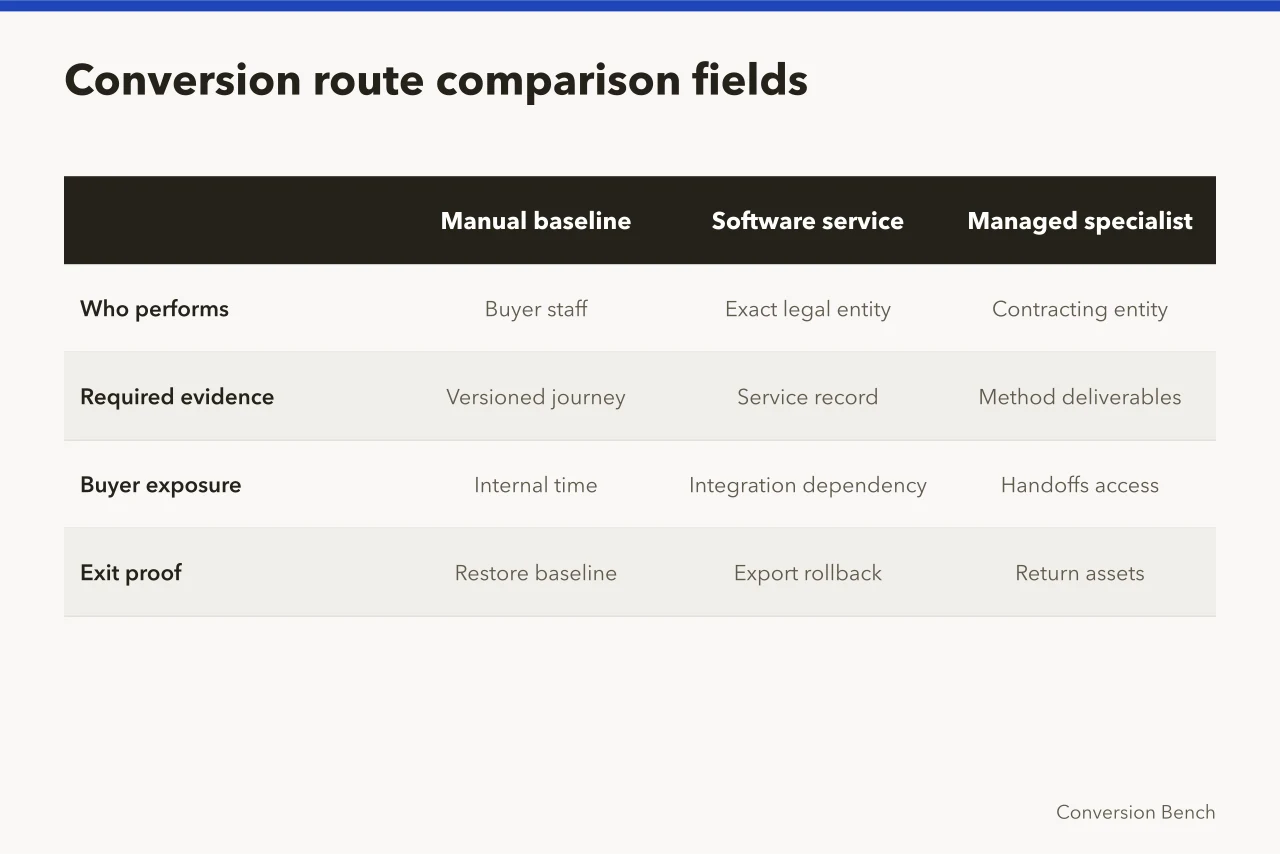
Compare the four named routes on identical fields
Compare the four named routes
Who performs the work
- Manual baseline, in-house, no vendor
- Buyer staff under current controls
- Software service, for example Shopify, WooCommerce or BigCommerce
- The vendor's contracting entity plus buyer configuration
- Managed specialist, for example Croud, Brainlabs or Conversion.com
- The agency's contracting entity, with scope fixed in writing
- Hybrid, for example Shopify Plus or Adobe Commerce with a named agency
- Buyer owner plus the named external component
Required evidence
- Manual baseline, in-house, no vendor
- Versioned journey, definitions, work log and current defects
- Software service, for example Shopify, WooCommerce or BigCommerce
- Service record, configuration, contract, data map and common test
- Managed specialist, for example Croud, Brainlabs or Conversion.com
- Method, deliverables, reviewer roles, data access and correction route
- Hybrid, for example Shopify Plus or Adobe Commerce with a named agency
- Responsibility map joining both evidence sets
Buyer exposure
- Manual baseline, in-house, no vendor
- Internal time and existing system limits
- Software service, for example Shopify, WooCommerce or BigCommerce
- Integration, supplier change and dependency
- Managed specialist, for example Croud, Brainlabs or Conversion.com
- Handoffs, remote access and evidential dependency
- Hybrid, for example Shopify Plus or Adobe Commerce with a named agency
- Interface failures and split accountability
Exit proof
- Manual baseline, in-house, no vendor
- Restore frozen baseline and retain decision record
- Software service, for example Shopify, WooCommerce or BigCommerce
- Usable export, access removal, deletion and rollback
- Managed specialist, for example Croud, Brainlabs or Conversion.com
- Return of assets, knowledge and records
- Hybrid, for example Shopify Plus or Adobe Commerce with a named agency
- Independent removal of the external part
For each route, leave price, effort, duration, thresholds and weights blank. If money is later included, use the same currency, VAT basis, period and unit. Match term, limits and refund treatment too. Do not compare a monthly licence with an undefined project fee.
Named products and providers on each route
Named products and providers
| Named example | Route | What it is | Price or plan |
|---|---|---|---|
| Shopify | Software | Hosted store, checkout and payments; Shopify Payments runs on Stripe | UK subscriptions billed monthly in pounds, entry tier typically around £25 a month; Plus is quote-based on annual contracts |
| WooCommerce | Software | Free WordPress plugin, self-hosted, so the merchant holds the data | Plugin free; hosting and extensions typically £10 to £40 a month |
| BigCommerce | Software | Hosted storefront with monthly tiers published by the vendor | Tiers published per month; contract and export terms set by the vendor |
| Optimizely | Software, testing | Web and feature experimentation sold on annual contracts | No published price, quoted through sales |
| VWO | Software, testing | A/B testing, plans quoted per month in US dollars | Entry paid plans typically in the low hundreds of dollars a month |
| Google Analytics 4 | Measurement | Free analytics; Analytics 360 is the paid tier | Free; 360 quoted by Google sales |
| Contentsquare | Measurement | Digital experience analytics; bought Hotjar in 2021 | Quote-based annual contracts |
| Hotjar | Measurement | Session recordings and surveys | Free tier with a daily session cap, plus paid monthly plans |
| Stripe | Payments | Card and wallet processing | Published rate card, 1.5% plus 20p per UK card, 2.5% plus 20p for EEA cards |
| Adyen | Payments | Enterprise acquiring | Pricing agreed per merchant, typically interchange-plus at larger volumes |
| Croud | Managed | UK performance marketing agency | Retainer, typically £5,000 to £15,000 a month |
| Brainlabs | Managed | Media and experimentation agency | Retainer, typically £5,000 to £20,000 a month |
| Conversion.com | Managed | London conversion optimisation agency | Project or retainer, typically from around £5,000 a month |
| Shopify Plus with a named agency | Hybrid | Buyer keeps the platform account, agency runs build and testing | Platform fee quoted annually, agency retainer on top |
Quote-based entries have no public list price. The rest are published rates.
Google Optimize, the free testing tool many merchants used, closed on 30 September 2023. Testing now means a paid tier or an agency contract.
Agency rates are quoted, not published: retainers typically run from about £5,000 a month for one channel to £20,000 or more where research, build and media sit in one contract. Scope, test volume and data work drive that range.
Use a shared test envelope
Each external route must first supply its identity, exact edition, UK availability, support and contractual record. The common synthetic test then presents approved product and price evidence, plus missing and duplicate events.
It covers refused non-exempt tracking and payment authorisation and capture. Refund and dispute states follow, then an accessible task. The final stages are access removal, rollback, export and deletion. No production customer data is permitted.
Common synthetic test envelope
- Supply identity, edition, UK availability, support
- Present approved product and price evidence
- Test missing and duplicate events
- Test refused non-exempt tracking
- Test payment authorisation and capture
- Test refund and dispute states
- Test access removal, rollback, export, deletion
ICO storage and access guidance makes refused tracking an operationally meaningful route. NCSC's online-service guidance supports scrutiny of identity, supply chain, logging, monitoring and incident handling. Those sources define review boundaries, not a pass for any candidate.
Preserve non-compensating decisions
Consumer price, privacy and PECR, accessibility and product safety are separate gates. So are payments, security, measurement validity, support and exit. A synthetic pass establishes only the recorded behaviour in that environment. It does not show lawfulness, customer benefit, sustained performance or causal uplift.
Non-compensating decision gates
Does the route pass every separate gate?
record behaviour only, not lawfulness
stop before commercial comparison
An observed rate also needs its eligible population, numerator and denominator. Period, timezone, missingness and post-order window matter too. HM Treasury's QPIE guidance explains why credible attribution depends on the comparison design. Supplier attribution is not automatically causal evidence.
Decision record
Select no route until the manual baseline and each admitted alternative have comparable fields. Record unknowns plainly. The merchant owner may later choose among candidates that clear every gate, but this comparison sets no universal winner and supplies no recommendation. Any material edition, contract, data-purpose or journey change returns that route to HOLD.
Before you act
- Define the product-to-post-order journey and its controls.
- Leave price, effort, duration, thresholds and weights blank.
- Require identity, edition, UK availability and contract record.
- Run the common synthetic test with no production customer data.
- Check each gate separately before comparing candidates.
- Record unknowns plainly and hold on material change.
Common questions
What does a synthetic test pass actually establish?
It establishes only the recorded behaviour in that environment. It does not show lawfulness, customer benefit, sustained performance or causal uplift. A pass is evidence of tested behaviour, not proof the route is legally sound or commercially better for the merchant.
Why must price and weights be left blank initially?
Leave price, effort, duration, thresholds and weights blank for each route. If money is later included, use the same currency, VAT basis, period, unit, term, limits and refund treatment. Comparing a monthly licence with an undefined project fee is not valid.
When should a route be returned to HOLD?
Any material edition, contract, data-purpose or journey change returns that route to HOLD. Select no route until the manual baseline and each admitted alternative have comparable fields, and record unknowns plainly rather than assuming them.
Which named options sit on each route?
Shopify, WooCommerce and BigCommerce sit on the software route. Croud, Brainlabs and Conversion.com sit on the managed route. Stripe and Adyen handle payments, and VWO, Optimizely and Contentsquare cover testing and measurement. A hybrid pairs one platform with a named agency contract, and the buyer keeps the account.